AI Automation
AI Missed Call Text-Back Automation That Saves Real Leads
Use ai missed call text back automation to answer missed callers fast, route leads, protect consent, and avoid brittle bot workflows.
ai missed call text back automation is a simple idea with a messy operational reality: when your team misses an inbound call, the system sends a useful text before the lead goes cold. Done well, it feels like a fast front desk. Done badly, it feels like a spammy bot that creates more cleanup than revenue.
Start by treating the workflow as a customer-response system, not a clever AI demo. The best version gives callers a clear next step, alerts the right person, records the lead, and keeps risky messages under human control.
| What you see | Likely cause | First move |
|---|---|---|
| Missed callers do not answer later callbacks | The response window closed before anyone followed up | Send a short text within a minute and ask what they need |
| Texts go out, but nobody owns the lead | The automation stops after the first message | Create an owner alert, CRM task, or shared inbox ticket |
| Customers reply with details the team never sees | Replies are not routed to the working queue | Route inbound SMS replies to the same owner as the missed call |
| Messages sound pushy or generic | The first reply is written like a campaign instead of a service response | Use plain language, acknowledge the missed call, and offer one next step |
| The system creates compliance anxiety | Consent, opt-out handling, and message purpose were not defined | Separate service replies from marketing and document your rules |
Where ai missed call text back automation fits
Use this workflow when phone calls still matter: home services, salons, clinics, real estate offices, agencies, contractors, cleaning companies, and local shops. A missed call is often a buying signal. The caller had enough intent to dial, then hit a dead end.
Think of the first text as an operational handoff. It should not try to close the entire job. It should say you missed the call, invite the caller to reply with the request, and give a safe next step such as booking, callback timing, or a simple intake question.
The basic workflow small teams can trust
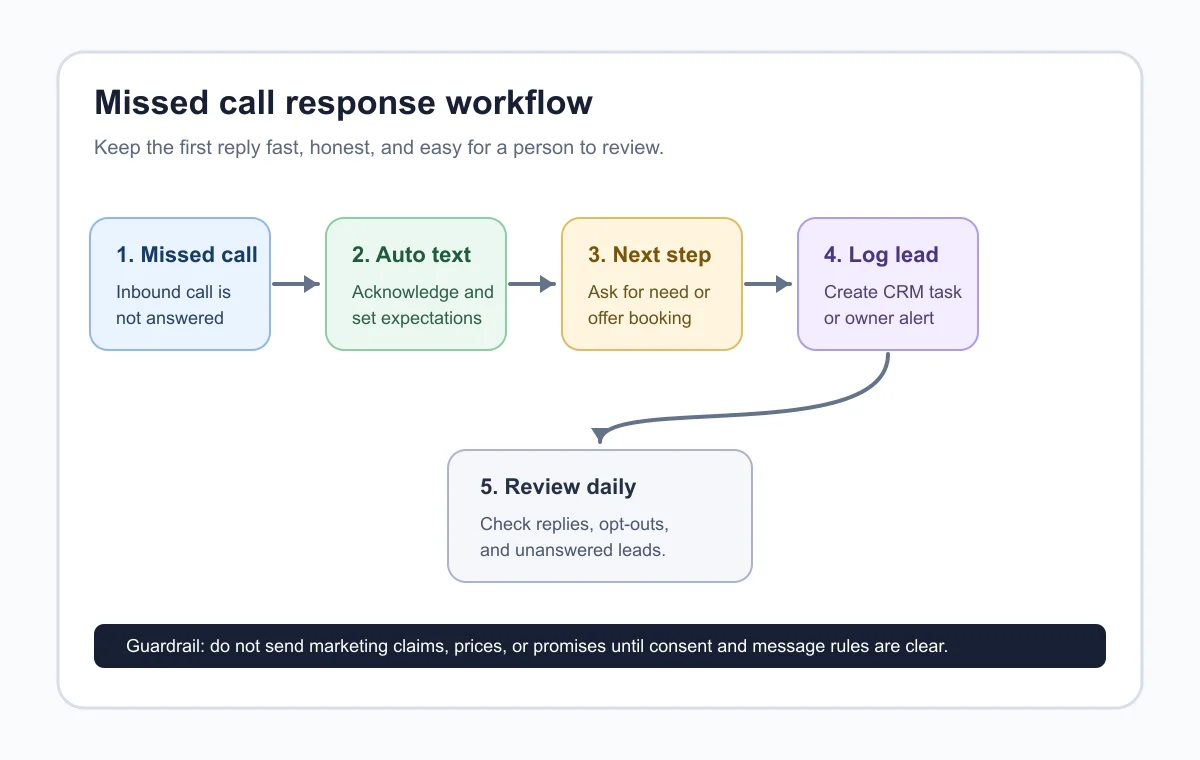
A reliable setup has five moving parts. First, your phone system must detect a missed inbound call. Then it sends a short SMS, records the contact, alerts the owner, and watches for replies or opt-outs.
- Trigger on missed inbound calls only. Filter out answered calls, internal test calls, spam numbers, and repeat events from the same caller inside a short window.
- Send one useful service text. A good default is: "Sorry we missed your call. Reply here with what you need, or book a time and we will help." Keep it direct.
- Attach context for the team. Log the caller number, time, call source, location or campaign if available, and whether the call landed during business hours.
- Create a human follow-up path. Send the owner a task, Slack alert, CRM note, or shared inbox item. Someone should know the text went out.
- Track replies and exceptions. If the caller replies with urgency, cancellation, complaint, price request, or private information, route it to a person.
For a broader front-desk model, pair this with an AI receptionist for small business and a safer AI lead follow-up automation sequence. The missed-call text is the first touch, not the whole sales process.
What the AI should actually do
AI is useful after the first reply, especially when callers answer with messy details. A model can classify the request, summarize the need, suggest urgency, draft a reply, and route the lead to the right person.
Keep the first version narrow. Let AI sort messages into buckets such as new lead, existing customer, appointment change, emergency, pricing question, complaint, spam, or needs owner review. Do not let it promise availability, quote prices, approve refunds, or make policy exceptions on its own.
Service businesses can adapt the same pattern by niche. See the home-service version in AI automation for home service business, the cleaning-company version in AI automation for cleaning business, and the property-lead version in AI automation for real estate agents.
Build or buy: the practical decision
Buying is usually faster if your CRM or phone platform already supports missed-call text back. Platforms such as HighLevel-style CRM systems, call tracking tools, and industry CRMs often include the trigger, message, inbox, and task routing in one place.
Building makes sense when you need deeper routing, custom CRM logic, or control over the caller experience. A common stack uses a phone provider webhook, an automation builder, a CRM, and an SMS provider. That stack gives you flexibility, but it also gives you more failure points to monitor.
- Buy when you need a working front-desk workflow this week and your team can live inside the platform's inbox.
- Build when you have multiple locations, custom lead scoring, unusual routing rules, or a CRM your phone tool cannot update cleanly.
- Pause when nobody owns follow-up, your contact data is messy, or your team has not agreed what messages are safe to automate.
For no-code implementation, compare the maintenance tradeoffs in Make vs Zapier for small business and the stack choices in No-Code AI Automation for Small Business. If calls turn into bookings, connect the handoff to AI appointment scheduling for small business.
Message rules that keep it from feeling spammy
Short beats clever. The caller already knows they called. Your text should acknowledge the miss, create a low-friction reply path, and avoid hype.
Use service language, not campaign language. "Sorry we missed your call" is safer and clearer than "Claim your exclusive offer now." If the caller wants a quote, appointment, or callback, ask for only the information needed to route the request.
- Keep the first message under two short sentences. Long texts look automated and bury the next step.
- Include the business name when helpful. Callers may not recognize the phone number later.
- Offer one primary action. Reply with the request, book a time, or confirm callback preference. Do not ask for five things.
- Respect STOP and similar opt-out replies. Make sure opt-outs are captured before any future automation runs.
- Separate after-hours wording. A midnight caller should get an expectation-setting message, not a promise of instant human help.
Guardrails before you turn it on
Good automation needs boring controls. Duplicate triggers, stale CRM owners, unmonitored inboxes, and aggressive copy cause most of the pain.
Create a short operating rule before launch: who receives alerts, how quickly missed-call replies are reviewed, what counts as urgent, which replies force human review, and when the system should stay silent. Put that rule in your SOP library so the workflow survives staff changes.
If the call becomes an intake process, borrow the structure from AI customer intake form automation. If it becomes a quote workflow, connect it to AI proposal automation for contractors. If the lead creates billing or account work later, tie the record to AI invoice automation for small business and AI CRM automation for small business.
How to test the workflow in one week
Run it in a controlled window first. You do not need a giant rollout to learn whether the workflow is useful.
- Day 1: Write three message variants: open hours, after hours, and fully booked or unavailable.
- Day 2: Test call detection with real missed calls, not only platform previews.
- Day 3: Confirm the reply lands in the team's working inbox or CRM queue.
- Day 4: Add owner alerts and make sure duplicate alerts do not fire.
- Day 5: Review every missed-call reply and adjust routing, wording, and escalation rules.
Connect adjacent admin work only after the first loop is stable. A missed-call lead may need AI email triage for small business, AI meeting notes automation, AI document automation for small business, or small-business SOPs built with AI. Add those pieces in order, not all at once.
Quick Checklist
- Trigger only on real missed inbound calls.
- Send one plain service reply before any AI enrichment.
- Log every missed call in the CRM or shared lead queue.
- Route customer replies to a person who owns follow-up.
- Use AI for classification, summaries, and draft suggestions first.
- Document consent, opt-out, after-hours, and escalation rules.
- Review the first week of conversations before expanding automation.
Missed-call text back works because it respects timing. The caller reached out first, and your business responds before the moment disappears. Keep the workflow useful, restrained, and easy to audit, and it can become one of the lowest-friction automations a small team runs.
Frequently Asked Questions
what is missed call text back automation?
Missed call text back automation sends a text message when an inbound call is not answered. The message usually acknowledges the missed call, invites the caller to reply, and routes the lead to a team member or CRM.
can ai reply to missed calls automatically?
AI can help classify replies, summarize caller needs, and draft follow-up messages. For most small businesses, the first outbound text should stay simple and rule-based, while AI handles the messy replies after the customer responds.
is missed call text back legal?
It depends on message purpose, consent, jurisdiction, and how you handle opt-outs. Treat the first response as a service reply to a recent caller, avoid promotional claims unless consent is clear, and ask counsel when your use case moves into marketing.
what should a missed call text say?
Use plain wording such as: "Sorry we missed your call. Reply here with what you need, or book a time and we will help." Add business-specific details only when they are accurate and easy to keep current.
what tools can send missed call text backs?
Phone systems, CRMs, call tracking tools, SMS providers, and automation builders can all support this workflow. The right choice depends on where your team already manages calls, texts, bookings, and lead follow-up.
how fast should a missed call text go out?
Send it quickly, usually within a minute, unless you have a reason to delay. The value comes from responding while the caller is still thinking about the problem they called to solve.
For related customer-facing automations, see AI customer service automation for small business, AI chatbot for a local business website, AI appointment scheduling for salons, and AI workflow automation for contractors.
Official sources: HighLevel: Where and how to configure Missed Call Text Back · FCC Order on TCPA consent revocation and robotext rules. Check current program pages before applying.