AI Automation
Build a Lead-Qualification Chatbot Your Small Business Can Trust
Set up an ai lead qualification chatbot small business teams can trust, with scoring questions, CRM routing, handoff rules, and safeguards.

An ai lead qualification chatbot small business setup should do one narrow job well: turn anonymous website visitors into sorted, usable sales conversations. It should ask better first questions, capture clean contact details, and route the lead without pretending every visitor is ready to buy.
For a lean team, the win is not a flashy bot. The win is fewer missed inquiries, faster follow-up, and a CRM record your salesperson can understand in ten seconds.
| What you see | Likely cause | First move |
|---|---|---|
| Visitors open chat but leave fast | The first question feels vague or salesy | Ask what outcome they need, then offer two or three clear choices |
| Leads arrive with no budget or timeline | The bot captures contact details too early | Move qualification questions before the email request |
| Good prospects wait too long | No urgent-lead routing rule exists | Create a hot-lead alert for high value, short timeline, or direct buying intent |
| Your CRM fills with junk records | Every chat becomes a lead | Only create CRM leads after a minimum fit score is reached |
| The bot gives risky promises | It is answering beyond approved sales rules | Restrict answers to approved pages, scripts, and handoff prompts |
Start With the Sales Decision, Not the Chatbot
Begin by writing down the exact moment when a human should step in. A roofing company, clinic, agency, or B2B service firm may all want the same thing, but their handoff triggers will be different.
Ask one practical question: what would make your best salesperson call this lead today? That answer becomes the scoring rule.
Small teams usually get better results from a controlled flow than from an open-ended AI conversation. A controlled flow can still feel natural, but it protects the business from random answers, missing fields, and inconsistent routing.
Ask Questions Your Team Will Actually Use
Strong qualification questions are short, specific, and tied to a decision. If your team never uses company size, do not ask for it. If service area changes whether you can help, ask for location early.
A useful first-pass script often covers need, fit, timing, budget, authority, and contact preference. For a local service business, fit may mean ZIP code and job type. For a consultant, it may mean company size and the problem they are trying to fix.
Keep the language plain. “What are you trying to get done?” usually beats “Which solution category are you interested in?” because people answer it without decoding your internal terms.
A simple scoring model
- Hot: clear buying intent, good-fit service, near-term timeline, and complete contact details.
- Warm: good-fit need, but budget, timing, or decision role is unclear.
- Nurture: early research, poor timing, or a need that requires education before sales contact.
- Disqualify: outside your service area, wrong service, spam, or no way to contact the visitor.
Route Leads Like an Operations Workflow
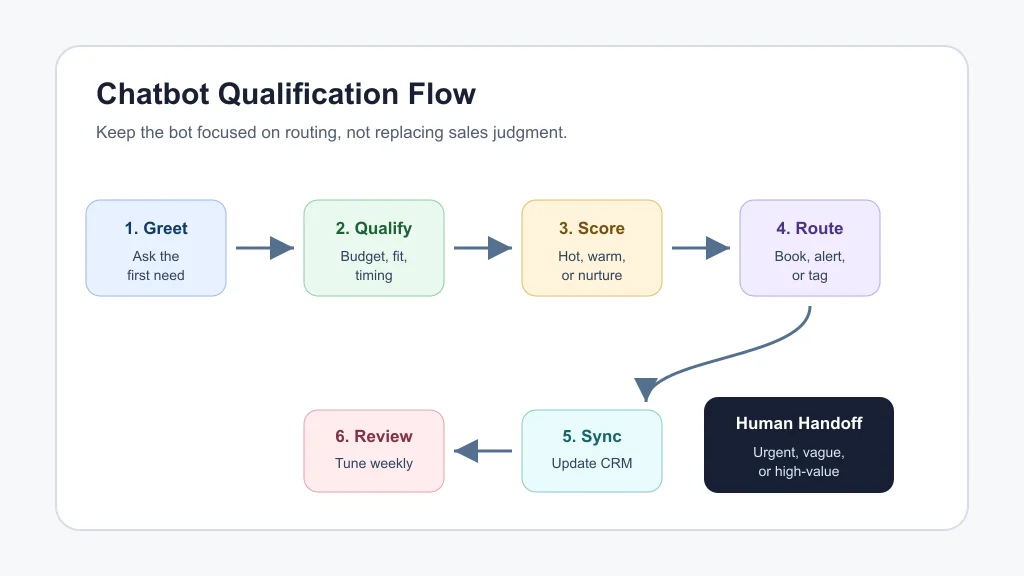
Lead qualification breaks when the chatbot stops at “thanks, someone will follow up.” The next step needs to be automatic and visible.
Hot leads should create an alert, a CRM task, or a booking option. Warm leads can enter a follow-up sequence. Bad-fit leads should receive a polite next step that does not waste staff time.
Map the process before picking tools. If you already use Zapier, compare your routing needs with Zapier AI agents for small business. If your flow needs heavier branching or self-hosted control, review n8n vs Zapier for small business before building around one platform.
Your CRM matters too. A bot that captures good answers but stores them in the wrong fields creates cleanup work. Pair the chatbot with a scoring model like the one in AI CRM lead scoring for small business, then test whether the sales view is actually useful.
Where AI Helps, and Where Rules Still Win
AI helps most when a visitor describes their need in messy language. It can summarize the conversation, detect urgency, classify the request, and suggest the next route.
Rules still win for hard business boundaries. Service area, minimum project size, regulated claims, credit terms, appointment availability, and refund promises should not be left to a model’s judgment.
Think of the bot as a front-desk filter. If your business also handles phone leads, the same routing logic should line up with AI phone answering service for small business and AI missed call text-back automation. Buyers should not get one answer in chat and a different answer by phone.
Protect the Customer Experience
People do not mind answering a few questions when the payoff is clear. They do mind a bot that traps them, repeats itself, or asks for private details too soon.
Add a visible escape route to a human. Also make sure the bot says what will happen next, such as “we will text you today,” “book a call,” or “we will email pricing options.”
Source control matters. If the chatbot answers service questions, use a maintained content base like the one discussed in customer support knowledge base automation. If it only qualifies sales leads, keep its answer set even tighter.
Review your first 50 conversations manually. You are looking for confusing wording, missed hot leads, bad disqualifications, and handoffs that happened too late.
Small-Business Implementation Plan
Start with one high-value entry point, usually your pricing page, service page, contact page, or quote request page. Do not launch the bot sitewide until the first flow is stable.
- Pick one offer. Choose the service or product where a faster response can actually change revenue.
- Write the qualification rules. Define hot, warm, nurture, and disqualified before touching software.
- Build the shortest useful script. Use five to seven questions, not a survey disguised as chat.
- Connect the CRM. Store answers in fields your team already checks.
- Set routing. Trigger alerts, bookings, tasks, or sequences based on score.
- Audit weekly. Tune questions and thresholds from real conversations.
Need a readiness pass first? Use an AI workflow audit checklist to spot weak handoffs, duplicate data entry, and missing owner decisions. For broader ownership, an AI operations assistant for a small business can help keep routing rules and follow-up tasks from drifting.
Tool Stack Choices That Usually Matter
Most small businesses need four pieces: a chat widget, a CRM, an automation layer, and a calendar or task system. Buying the most advanced chatbot does not fix a weak CRM process.
If your CRM is the center of sales work, compare CRM automation tools for small teams before choosing the bot. If your front desk handles calls, appointment changes, and simple questions, compare an AI receptionist vs virtual assistant so chat does not become a disconnected channel.
For service businesses, the qualification flow should connect to quote and estimate work. That may mean AI quote follow-up automation, AI estimate automation for contractors, or a broader AI automation for a home service business playbook.
Measure What Sales Can Feel
Do not judge the bot by chat volume alone. A high number of conversations can still be a bad result if your team receives low-fit names with no context.
Track qualified lead rate, meeting-booking rate, speed to first human touch, CRM field completion, and revenue from chatbot-sourced deals. Then compare that to the time saved by filtering poor-fit leads.
For budget decisions, run the numbers with an AI workflow automation ROI calculator. Include software fees, setup time, monthly review time, and any extra sales lift from faster response.
Be honest about adjacent workflows. If your team is still buried in inbox sorting, AI email triage may improve follow-up more than adding another chatbot. If sales calls create scattered notes, AI meeting notes automation may close the loop after the bot books the call.
Common Mistakes to Avoid
Launching with too many questions is the first mistake. Asking for name, email, phone, company, budget, timeline, address, and pain point before giving any value feels like paperwork.
Another mistake is letting the bot qualify leads without a disqualification path. Every business has bad-fit inquiries. A polite “we are not the right fit” route is better than filling your pipeline with work you will never take.
Watch for automation sprawl too. A lead chatbot can connect with calendars, email, SMS, CRM, quotes, bookkeeping, and support. That does not mean it should. The same restraint used in AI automation mistakes small business owners make applies here.
Back-office examples can help set boundaries. AI bookkeeping automation and AI invoice reminders work best when the rules are narrow and the exceptions are clear. Lead qualification is no different.
Quick Checklist
- Choose one sales page or service line for the first chatbot launch.
- Define hot, warm, nurture, and disqualified criteria before building.
- Ask only questions your team uses for routing or follow-up.
- Create a human handoff for urgent, vague, sensitive, or high-value chats.
- Sync answers into the correct CRM fields, not only the conversation transcript.
- Review real chats every week for the first month.
- Measure booked meetings and qualified pipeline, not just chat starts.
A lead-qualification chatbot is worth building when it makes your team faster and your follow-up clearer. Keep the scope narrow, protect the handoff, and tune the flow from real conversations instead of treating launch day as the finish line.
Official sources: Salesforce guide to lead generation chatbots · HubSpot Knowledge Base on creating a rule-based chatbot.
Frequently Asked Questions
what is an ai lead qualification chatbot for small business?
It is a website chat system that asks first-touch sales questions, records the answers, scores the visitor, and sends the right next step to your CRM, calendar, or team inbox.
how much should a small business automate lead qualification?
Automate the first pass only. Let the bot capture intent, budget, timeline, service area, and contact details, then send unclear or high-value conversations to a person.
what questions should a lead qualification chatbot ask?
Start with the problem, location or service area, timing, budget range, decision role, and preferred contact method. Add only the questions your team truly uses to prioritize follow-up.
can a chatbot replace a sales rep for small business leads?
Usually no. The chatbot should filter, route, and prepare the conversation. A person should still handle negotiation, sensitive details, custom pricing, and edge cases.
how do I know if my lead chatbot is working?
Track qualified conversations, booked meetings, speed to first human reply, bad-fit leads filtered out, and deals created from chatbot-sourced contacts.